
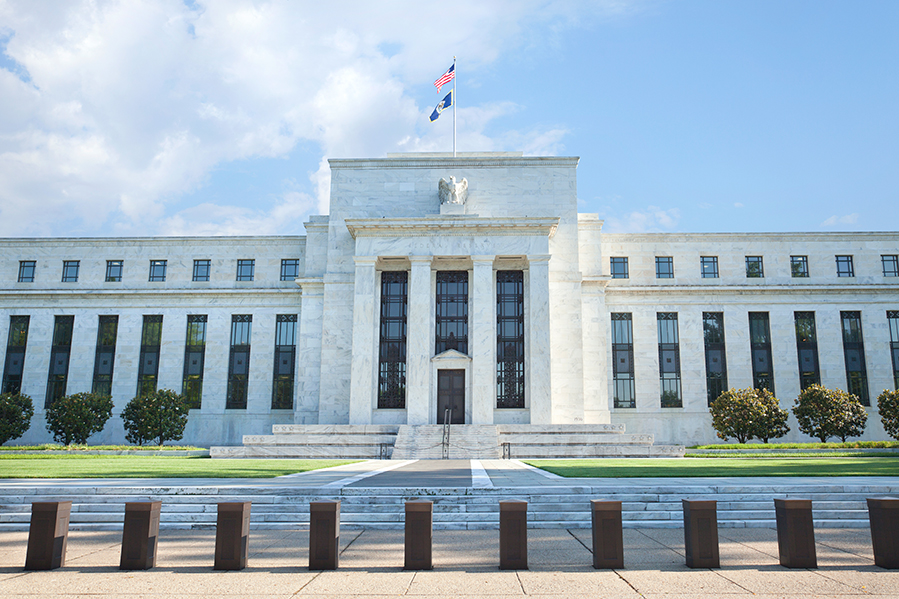
 Despite what you might think, the Fed does not set economic policy
While the Federal Reserve’s decisions certainly impact the US (and global) economy, it’s important to know that the Fed does not set economic policy. The Fed does, however, control monetary policy in an attempt to influence the direction of the US economy. Let’s explore the history of the Federal Reserve, its role and how it carries out its mandate.
Historical Perspective
Up until the early part of the 20th century, there was no central control or coordination of banking activity in the United States. In fact, the US was the only major industrial nation without a central bank until Congress established the Federal Reserve System in 1913 with the enactment of the Federal Reserve Act.
But rather than create a single central bank, the Federal Reserve Act provided for a central banking “system” with three distinguishing features: (1) a central governing Board, (2) a decentralized operating structure of 12 Reserve Banks, and (3) a combination of public and private characteristics. In other words, the Federal Reserve System is the central bank of the United States.
Serving the Public Interest
The authors of the Federal Reserve Act intentionally created a framework so that the Federal Reserve System is not “owned” by anyone. Instead, the Fed is an independent entity within the government.
And while the Fed derives its authority from Congress, its monetary policy decisions do not have to be approved by anyone in the legislative or executive branches of the government, including the President.
The reason the Fed exists is simple: to serve the public interest by promoting the health of the US economy and the stability of the US financial system. And while there are many functions performed by the Fed, there is one function that garners the most attention. As copied from www.federalreserve.gov, the Federal Reserve:
- conducts the nation’s monetary policy to promote maximum employment, stable prices, and moderate long-term interest rates in the US economy
Other Federal Reserve functions include promoting the stability of the financial system and soundness of individual financial institutions, but let’s examine what most consider to be the Fed’s primary mandate and how it carries out that mandate.
The Fed’s Mandate
With the Federal Reserve Act, Congress set three very specific goals for the Fed: to promote maximum sustainable employment, stable prices, and moderate long-term interest rates.
Maximum sustainable employment is exactly what it sounds like – the highest level of employment that the economy can sustain while maintaining a stable inflation rate. And keep in mind that the highest level of employment is not 100% – because that is simply not sustainable.
Prices are considered stable when they are not rising or falling quickly, which in turn allows businesses and consumers to invest, borrow or lend for longer periods of times. And this “stability of prices” is measured by the rate of inflation, which is defined as the rate at which the general level of prices for goods and services is rising. If inflation is high, at say 10% – as it was in the 1970s – then a loaf of bread that costs $1 this year will cost $1.10 the next year. Consequently, the purchasing power of our currency is falling when inflation is high.
Therefore, in order to help the Fed attempt to stabilize prices, Congress gave the Fed a very powerful tool: the ability to set monetary policy – often called manipulating the money supply. And one way the Fed sets monetary policy is by manipulating short-term interest rates in an effort to control inflation.
How the Fed Does It
The Federal Open Market Committee is the monetary policymaking body of the Federal Reserve System. The FOMC is composed of 12 members – seven members of the Fed Board of Governors and five of the 12 Federal Reserve Bank presidents. All of the Reserve Bank presidents, including those who are not voting members, attend FOMC meetings, participate in the discussions, and contribute to the assessment of the economy and policy options.
If the Fed believes that prevailing market conditions will increase inflation, it will attempt to slow the economy by raising short-term interest rates – reasoning that increases in the cost of borrowing money are likely to slow down both personal and business spending. The flip side is true too: if the Fed believes that the economy has slowed too much, it will lower short-term interest rates in an effort to lower the cost of borrowing and stimulate personal and business spending.
As you might imagine, the Fed walks a very fine line. If it does not slow the economy soon enough by raising rates, it runs the risk of inflation getting out of control. And if the Fed does not help the economy soon enough by lowering rates, it runs the risk of the economy going into recession.
Source: Copyright © 2024 RSW Publishing. All rights reserved. Distributed by Financial Media Exchange.



 Megan Jones joined the ILG Financial team in 2020 as marketing director. Megan and her husband live in Fredericksburg, VA with their German Short Haired Pointer, Gus. Megan is a graduate of Longwood University and holds a degree in communications. Megan is the oldest of Dave Lopez’s three children and not only enjoys working alongside her father, but also with her cousin, Chase, who joined the ILG Financial team in 2020 as an advisor. Megan is also a fully licensed Life, Health, and Annuity agent. When not at work, Megan enjoys sitting on the back porch with family and friends enjoying food and music.
 Amy Anderson joined the ILG Financial team in 2023 as the client relations coordinator. Her responsibilities include scheduling of appointments, annual check-up notifications, and annuity and required minimum distribution assistance. She is a graduate of Harding University with a degree in Computer Information Systems. Amy and her husband have two children and she enjoys reading, crocheting, music and spending time with her family.
 Terri Center joined the ILG Financial team in 2019 as client services manager. She handles client records, application processing, and gathering information to provide a professional and friendly experience with all of our clients. Terri is a graduate of Oakland University. She is married and has two children. She enjoys hiking, family time, and puzzle challenging video games. She also likes to share her creativity in her canvas paintings and sewing projects.
 Jessica Carson joined the ILG Financial team in 2018 as an agent. Jessica and her husband have four children, two dogs, 3 barn cats, 5 chickens, and three parakeets. She indeed loves her children and pets! When not at work, Jessica enjoys playing the piano and cello as well as traveling and spending time outside with her family, hiking, fishing, and boating.
 Chase Lopez joined the ILG Financial team in 2020 as an advisor. Chase is a 2016 James Madison University graduate with a degree in management. Chase has been trained under the tutelage of Dave Lopez, who is not only the founder and managing member of ILG Financial, but also is Chase’s uncle and godfather. He also enjoys working alongside his cousin, Megan, who is Dave’s daughter.