
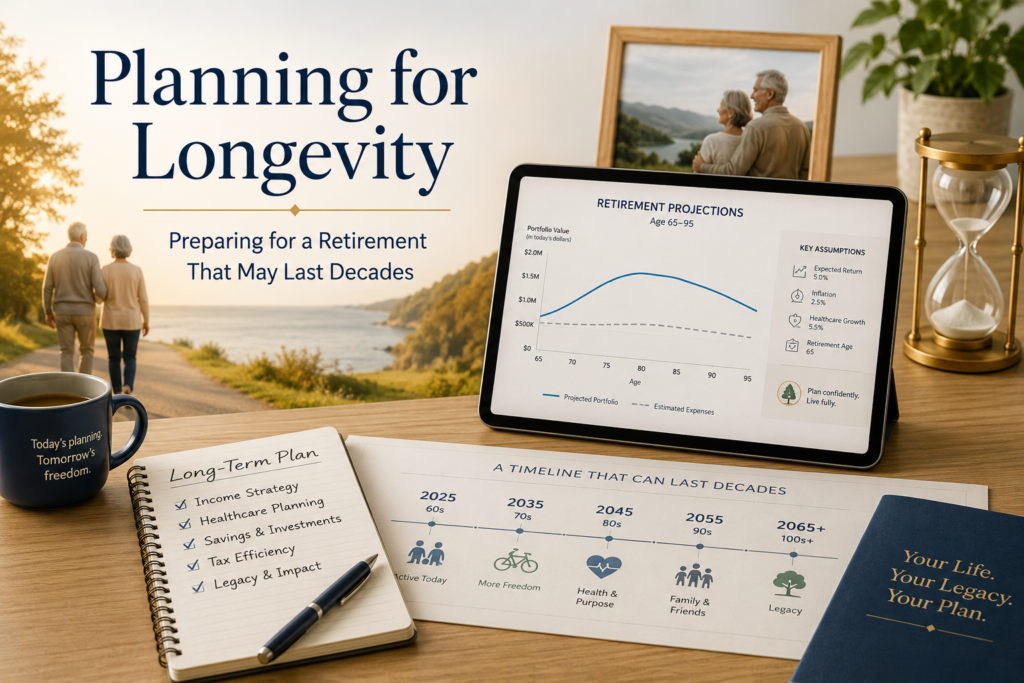
Retirement today often looks different than it did for previous generations. Advances in healthcare, improved living conditions, and increased awareness of healthy lifestyle habits have contributed to longer life expectancies for many Americans.
While living longer can create opportunities for additional experiences and time with family, it also introduces important financial considerations. Retirement may last 20, 30, or even more years, making longevity planning an essential part of a comprehensive financial strategy.
Preparing for a longer retirement requires more than simply accumulating assets. It involves creating a flexible plan that can adapt to changing circumstances over time.
Understanding Longevity Risk
One of the most significant challenges retirees face is longevity risk. This refers to the possibility of living longer than anticipated and potentially exhausting financial resources during retirement.
Longevity risk can be difficult to predict because no one knows exactly how long retirement will last. However, acknowledging this possibility allows individuals and families to build plans that account for a range of future outcomes.
Rather than focusing on a specific retirement timeline, many financial plans benefit from incorporating flexibility and periodic reviews.
Creating Sustainable Retirement Income
For many retirees, the transition from accumulating savings to generating income represents a significant financial shift.
Retirement income may come from several sources, including:
- Social Security1 benefits
- Employer-sponsored retirement plans
- Individual retirement accounts (IRAs)
- Taxable investment accounts
- Pension income
- Part-time employment or consulting work
A diversified income strategy may help create flexibility when economic conditions change. Reviewing income sources regularly can help ensure they continue to support spending needs throughout retirement.
Planning for Healthcare Expenses
Healthcare costs often become a larger component of retirement spending as individuals age.
While Medicare2 may help cover many healthcare expenses, retirees should also consider:
- Premiums and out-of-pocket expenses
- Prescription medication costs
- Supplemental insurance coverage
- Dental and vision care
- Potential long-term care needs
Incorporating healthcare expenses into retirement planning can provide a more realistic picture of future spending requirements.
Managing Inflation Over Time
Even moderate inflation can affect purchasing power over an extended retirement period.
For example, expenses that seem manageable today may increase significantly over two or three decades. Housing, healthcare, food, and transportation costs can all change over time.
This is one reason many retirement strategies include investments that offer the potential for long-term growth alongside more conservative assets designed to support income needs.
Balancing Current Lifestyle and Future Needs
Retirement spending often changes throughout different stages of life.
Many retirees spend more during the early years of retirement when travel, hobbies, and family activities are priorities. Later years may bring different spending patterns, including increased healthcare-related expenses.
Understanding these potential shifts can help individuals build a plan that accommodates both current lifestyle goals and future financial needs.
Reviewing Asset Allocation
A longer retirement horizon may influence how investments are allocated.
While risk tolerance varies from person to person, retirees often need to balance income needs with continued growth potential. Maintaining some exposure to growth-oriented investments may help address inflation and support long-term objectives.
Regular reviews can help ensure that investment allocations remain aligned with retirement goals, spending needs, and evolving circumstances.
Planning for Family and Legacy Goals
Longevity planning often extends beyond personal financial needs.
Many individuals also consider:
- Supporting a spouse or partner
- Assisting children or grandchildren
- Charitable giving objectives
- Estate planning goals
These priorities can influence decisions regarding savings, investments, and asset distribution strategies.
Reviewing beneficiary designations, wills, trusts, and healthcare directives periodically can help keep these plans aligned with current wishes.
The Importance of Ongoing Reviews
Retirement planning is not a one-time event. Circumstances, goals, tax laws, market conditions, and healthcare needs can all change over time.
Conducting regular reviews allows individuals to evaluate progress and make adjustments when necessary. This process can help maintain alignment between financial resources and retirement objectives.
Planning for Longevity: Final Thoughts
Longer life expectancy creates both opportunities and challenges for retirees. While no one can predict exactly how long retirement will last, thoughtful planning can help prepare for a range of possibilities.
By considering retirement income, healthcare expenses, inflation, investment strategy, and family priorities, individuals can create a financial framework designed to adapt over time.
Longevity planning is ultimately about preparing for the future while maintaining flexibility along the way. Regular reviews and thoughtful decision-making can help keep your retirement strategy aligned with your evolving needs and goals.
Sources:
- [1] https://www.ssa.gov/
- [2] https://www.medicare.gov/
Recent Posts
 This Charge Doesn’t Add Up
- Scam of the Month: One Letter Away from a Scam
 Tax Diversification in Retirement: Building Flexibility for Future Income Needs
 Understanding the Difference Between Risk Tolerance, Risk Capacity, and Financial Goals
 Back-to-Routine Money Reset: Taking Stock Before the End of the Year
- Scam of the Month: This Job Won’t Work
 Planning for Longevity: Preparing for a Retirement That May Last Decades
 Why Putting Your Financial Strategy in Writing Matters
 Summer Financial Checkup: Reviewing Your Progress and Priorities
- Scam of the Month: FIFA Phishing
 Four Financial Scams Targeting Seniors
- Scam of the Month: Fake It ‘Til They Take It
- How Much Do You Really Need to Retire?
 How to Prioritize Multiple Financial Goals at Once
 The Pros and Cons of Consolidating Investment Accounts








 Megan Jones joined the ILG Financial team in 2020 as marketing director. Megan and her husband live in Fredericksburg, VA with their German Short Haired Pointer, Gus. Megan is a graduate of Longwood University and holds a degree in communications. Megan is the oldest of Dave Lopez’s three children and not only enjoys working alongside her father, but also with her cousin, Chase, who joined the ILG Financial team in 2020 as an advisor. Megan is also a fully licensed Life, Health, and Annuity agent. When not at work, Megan enjoys sitting on the back porch with family and friends enjoying food and music.
 Amy Anderson joined the ILG Financial team in 2023 as the client relations coordinator. Her responsibilities include scheduling of appointments, annual check-up notifications, and annuity and required minimum distribution assistance. She is a graduate of Harding University with a degree in Computer Information Systems. Amy and her husband have two children and she enjoys reading, crocheting, music and spending time with her family.
 Terri Center joined the ILG Financial team in 2019 as client services manager. She handles client records, application processing, and gathering information to provide a professional and friendly experience with all of our clients. Terri is a graduate of Oakland University. She is married and has two children. She enjoys hiking, family time, and puzzle challenging video games. She also likes to share her creativity in her canvas paintings and sewing projects.
 Jessica Carson joined the ILG Financial team in 2018 as an agent. Jessica and her husband have four children, two dogs, 3 barn cats, 5 chickens, and three parakeets. She indeed loves her children and pets! When not at work, Jessica enjoys playing the piano and cello as well as traveling and spending time outside with her family, hiking, fishing, and boating.