
When most people think about tax diversification in retirement, they think about investments. Diversifying among stocks, bonds, and other assets is a common strategy for managing risk within a portfolio. However, diversification can extend beyond investments alone. Tax diversification is another important consideration, particularly for individuals preparing for retirement.
Tax diversification refers to maintaining assets across different tax categories, which may provide greater flexibility when creating retirement income strategies. By understanding how different accounts are taxed, retirees may be better positioned to adapt to changing circumstances throughout retirement.
What Is Tax Diversification?
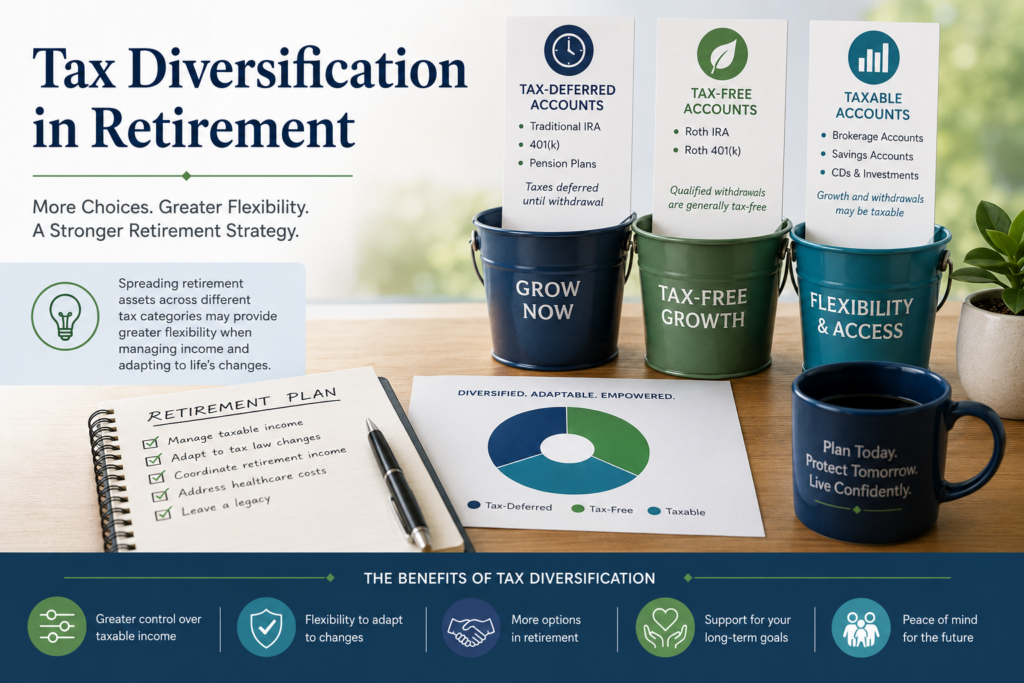
Tax diversification1 in retirement involves spreading retirement assets across accounts that receive different tax treatment.
Generally, retirement assets may fall into three categories:
- Tax-deferred accounts
- Tax-free accounts
- Taxable accounts
Each category has distinct rules regarding contributions, growth, and withdrawals.
Maintaining a mix of these account types may provide additional options when making retirement income decisions.
Understanding Tax-Deferred Accounts
Tax-deferred accounts allow individuals to postpone taxes until funds are withdrawn.
Examples include:
- Traditional IRAs
- Traditional 401(k) plans
- Certain pension arrangements
Contributions may reduce taxable income during working years, and investment growth occurs without current taxation.
However, withdrawals are generally taxed as ordinary income, and required minimum distributions (RMDs) may apply at certain ages.
Understanding Tax-Free Accounts
Tax-free retirement assets are typically funded with after-tax dollars.
Examples may include:
- Roth IRAs
- Roth 401(k) accounts
Qualified withdrawals are generally not subject to federal income tax, assuming applicable requirements are met.
These accounts may provide flexibility during retirement because withdrawals generally do not increase taxable income.
Understanding Taxable Accounts
Taxable accounts include assets that do not receive special retirement account tax treatment.
Examples include:
- Individual brokerage accounts
- Bank accounts
- Certificates of deposit
- Certain investment holdings
While earnings, dividends, and capital gains may be subject to taxation, these accounts often provide flexibility regarding withdrawal timing and access to funds.
Why Tax Diversification Matters
Tax laws, income needs, and personal circumstances can change over time.
Relying heavily on a single account type may limit flexibility when determining where retirement income should come from.
A diversified tax strategy may provide options when:
- Managing annual taxable income
- Responding to changes in tax laws
- Coordinating retirement withdrawals
- Planning charitable giving strategies
- Addressing healthcare-related costs
Having multiple sources of retirement income may allow individuals to make more informed decisions based on current circumstances.
Managing Retirement Income More Efficiently
Retirement income planning often involves determining which accounts to draw from and when.
For example, retirees may have access to:
- Social Security benefits
- Taxable investment accounts
- Traditional retirement accounts
- Roth accounts
Drawing income from a combination of sources may provide greater control over taxable income in a given year.
Because every situation is unique, withdrawal strategies should be evaluated based on individual goals, tax considerations, and financial needs.
Why Risk Tolerance Should Be Reviewed Regularly
Risk tolerance is not necessarily fixed.
Life events and changing circumstances can influence how investors view risk over time.
Examples may include:
- Marriage or divorce
- Career changes
- Retirement
- Inheritance
- Changes in health
- New financial responsibilities
Regular reviews can help ensure that investment strategies continue to align with both financial goals and personal preferences.
Tax Diversification and Required Minimum Distributions (RMDs)
RMDs can become an important consideration for retirees with significant balances in tax-deferred accounts.
Since these distributions may increase taxable income, maintaining assets in multiple account types may provide additional flexibility when planning future withdrawals.
While tax diversification in retirement does not eliminate taxes, it may create more choices regarding how retirement income is structured.
Balancing Contributions During Working Years
Tax diversification often begins before retirement.
Individuals saving for retirement may consider whether contributions should be allocated among different account types based on factors such as:
- Current income
- Expected future tax rates
- Retirement timeline
- Financial objectives
Because future tax laws and personal circumstances are uncertain, maintaining flexibility may be beneficial.
The Importance of Professional Guidance
Tax diversification involves multiple variables, including tax rules, retirement income planning, investment strategy, and estate planning considerations.
Working with qualified tax and financial professionals can help individuals evaluate how various account types fit within their broader financial plan.
Periodic reviews may also help identify opportunities as circumstances evolve over time.
Tax Diversification in Retirement: Final Thoughts
Tax diversification in retirement is about creating flexibility rather than predicting future tax environments.
By maintaining assets across taxable, tax-deferred, and tax-free accounts, retirees may have additional options when managing retirement income and responding to changing financial circumstances.
As part of a comprehensive retirement strategy, tax diversification can help support thoughtful decision-making throughout retirement while keeping long-term goals in focus.
Source:
- [1] https://www.investopedia.com/terms/d/diversification.asp
Recent Posts
 Tax Diversification in Retirement: Building Flexibility for Future Income Needs
 Understanding the Difference Between Risk Tolerance, Risk Capacity, and Financial Goals
 Back-to-Routine Money Reset: Taking Stock Before the End of the Year
 Scam of the Month: This Job Won’t Work
 Planning for Longevity: Preparing for a Retirement That May Last Decades
 Why Putting Your Financial Strategy in Writing Matters
 Summer Financial Checkup: Reviewing Your Progress and Priorities
- Scam of the Month: FIFA Phishing
 Four Financial Scams Targeting Seniors
- Scam of the Month: Fake It ‘Til They Take It
- How Much Do You Really Need to Retire?
 How to Prioritize Multiple Financial Goals at Once
 The Pros and Cons of Consolidating Investment Accounts
 Rethinking Retirement Timing: “Traditional” Retirement?
 Mid-Year Tax Planning: Strategies to Consider Before The Fall








 Megan Jones joined the ILG Financial team in 2020 as marketing director. Megan and her husband live in Fredericksburg, VA with their German Short Haired Pointer, Gus. Megan is a graduate of Longwood University and holds a degree in communications. Megan is the oldest of Dave Lopez’s three children and not only enjoys working alongside her father, but also with her cousin, Chase, who joined the ILG Financial team in 2020 as an advisor. Megan is also a fully licensed Life, Health, and Annuity agent. When not at work, Megan enjoys sitting on the back porch with family and friends enjoying food and music.
 Amy Anderson joined the ILG Financial team in 2023 as the client relations coordinator. Her responsibilities include scheduling of appointments, annual check-up notifications, and annuity and required minimum distribution assistance. She is a graduate of Harding University with a degree in Computer Information Systems. Amy and her husband have two children and she enjoys reading, crocheting, music and spending time with her family.
 Terri Center joined the ILG Financial team in 2019 as client services manager. She handles client records, application processing, and gathering information to provide a professional and friendly experience with all of our clients. Terri is a graduate of Oakland University. She is married and has two children. She enjoys hiking, family time, and puzzle challenging video games. She also likes to share her creativity in her canvas paintings and sewing projects.
 Jessica Carson joined the ILG Financial team in 2018 as an agent. Jessica and her husband have four children, two dogs, 3 barn cats, 5 chickens, and three parakeets. She indeed loves her children and pets! When not at work, Jessica enjoys playing the piano and cello as well as traveling and spending time outside with her family, hiking, fishing, and boating.