
Buying and selling investments is a normal part of many financial plans, but the timing of those transactions can affect more than portfolio performance. It may also influence how investment gains are taxed.
Understanding the difference between short-term and long-term capital gains is an important part of tax-aware investing. While taxes should not be the sole factor driving investment decisions, recognizing how holding periods may affect tax treatment can help investors evaluate their options more thoughtfully.
A basic understanding of capital gains can also make conversations with financial and tax professionals more productive as you work toward your long-term financial goals.
What Is a Capital Gain?
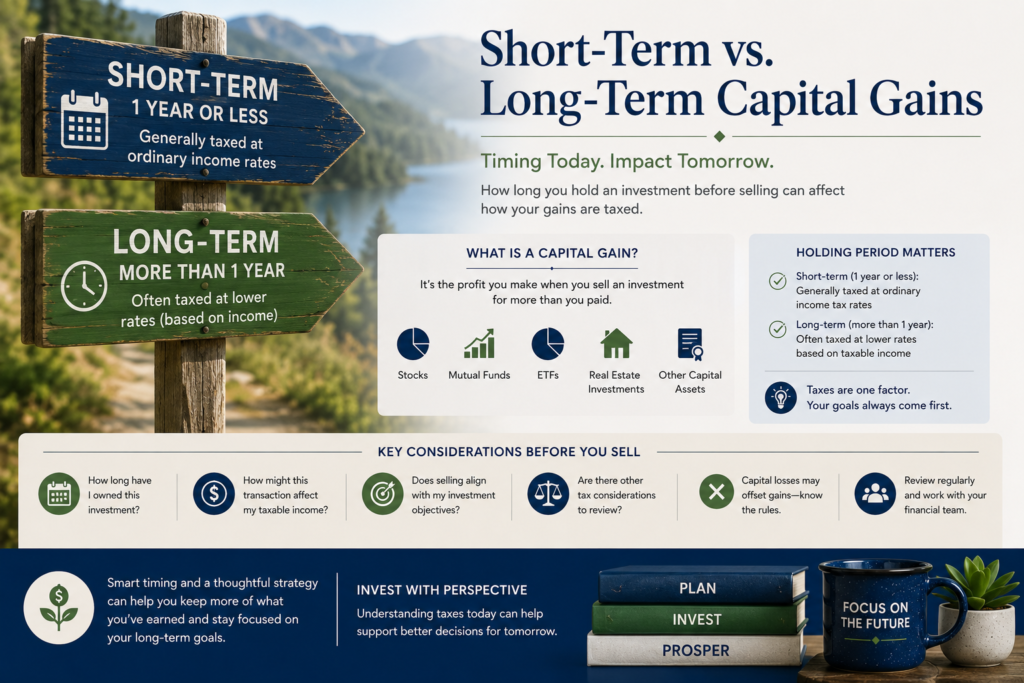
A capital gain1 occurs when you sell an asset for more than its purchase price. Capital gains can result from the sale of investments such as:
- Stocks
- Mutual funds
- Exchange-traded funds (ETFs)2
- Bonds
- Certain real estate investments
- Other capital assets
If an asset is sold for less than its purchase price, the result is generally considered a capital loss.
Whether a gain is classified as short-term or long-term depends primarily on how long the asset was held before it was sold.
Understanding Short-Term Capital Gains
Short-term capital gains generally apply to assets held for one year or less before being sold.
Under current federal tax rules, short-term capital gains are generally taxed at ordinary income tax rates. As a result, the tax treatment may differ from that of long-term capital gains depending on an individual’s tax situation.
Because tax outcomes vary based on personal circumstances, investors should consult qualified tax professionals regarding their specific situations.
Understanding Long-Term Capital Gains
Long-term capital gains generally apply to assets held for more than one year before they are sold.
Long-term gains often receive different federal tax treatment than short-term gains, although the applicable rate depends on factors such as taxable income and current tax law.
Holding an investment longer does not automatically make it the right decision. Instead, the holding period is one factor among many that investors may consider when evaluating whether to buy or sell an investment.
Why Holding Periods Matter
The timing of an investment sale may affect both taxes and long-term financial planning.
Before selling an investment, investors may want to consider questions such as:
- How long have I owned this investment?
- How might this transaction affect my taxable income?
- Does selling align with my investment objectives?
- Are there other tax considerations that should be reviewed?
Considering these questions can help place investment decisions within the context of an overall financial plan rather than focusing on taxes alone.
The Role of Capital Losses
Capital losses may offset capital gains in certain situations, subject to IRS rules.
Some investors review realized gains and losses before year-end to better understand their tax position.
This process, sometimes referred to as tax-loss harvesting, involves careful evaluation of investment holdings and applicable tax rules. Because the strategy is subject to specific requirements, professional guidance is often appropriate.
Capital Gains and Retirement Accounts
It is also helpful to understand that not all investment accounts are taxed the same way.
For example:
- Traditional IRAs and many employer-sponsored retirement plans generally follow different tax rules than taxable brokerage accounts.
- Roth accounts have their own tax treatment and distribution requirements.
- Taxable investment accounts are generally where capital gains rules most often apply.
Recognizing these differences can help investors understand how various account types fit within a broader financial strategy.
Avoid Letting Taxes Drive Every Decision
While tax planning is important, it should generally be viewed as one component of an overall investment strategy.
Selling or holding an investment solely because of potential tax consequences may not always align with broader financial objectives.
Investment decisions often involve balancing multiple considerations, including:
- Financial goals
- Risk tolerance
- Time horizon
- Portfolio diversification
- Cash flow needs
- Tax implications
Looking at these factors together can help support more informed decision-making.
Review Investment Activity Throughout the Year
Many investors wait until the end of the year to think about taxes. However, reviewing investment activity periodically may provide additional opportunities for planning.
Regular portfolio reviews can help you:
- Monitor realized gains and losses
- Evaluate changes in your investment strategy
- Discuss tax considerations with your advisors
- Prepare for year-end decisions before deadlines approach
Taking a proactive approach allows more time to evaluate available options.
Putting Capital Gains Into Perspective
Understanding the difference between short-term and long-term capital gains is an important part of becoming a more informed investor. While holding periods may influence tax treatment, they represent just one factor in the investment decision-making process.
By considering taxes alongside your financial goals, investment strategy, and overall plan, you can make decisions that reflect your unique circumstances. Working with qualified financial and tax professionals can also help you understand how capital gains may fit into your broader financial picture.
Sources:
- [1] https://www.investopedia.com/terms/c/capitalgain.asp
- [2] https://www.investopedia.com/terms/e/etf.asp
Recent Posts
 Buckle Up: Why Markets Could Get Bumpy This Fall
 Setting Effective Financial Goals for Sustainable Success
 Understanding Where Protected Income Strategies May Fit Within a Retirement Plan
 Charitable Giving Strategies: Planning Your Giving Before Year-End to Support Causes That Matter to You
 Taking a Proactive Approach to Important Financial Decisions Before Year-End
 This Charge Doesn’t Add Up
- Scam of the Month: One Letter Away from a Scam
 Tax Diversification in Retirement: Building Flexibility for Future Income Needs
 Understanding the Difference Between Risk Tolerance, Risk Capacity, and Financial Goals
 Back-to-Routine Money Reset: Taking Stock Before the End of the Year
- Scam of the Month: This Job Won’t Work
 Planning for Longevity: Preparing for a Retirement That May Last Decades
 Why Putting Your Financial Strategy in Writing Matters
 Summer Financial Checkup: Reviewing Your Progress and Priorities
- Scam of the Month: FIFA Phishing



 Israel Chavez, Jr. joined the ILG Financial team in 2026 as a Service Advisor. A graduate of Howard University, Israel was also a Division I student-athlete, competing as a goalkeeper for the university’s soccer program. His experience balancing academics and collegiate athletics helped shape the discipline and competitive mindset he brings to his role at ILG Financial.
 Megan Jones joined the ILG Financial team in 2020 as marketing director. Megan and her husband live in Fredericksburg, VA with their German Short Haired Pointer, Gus. Megan is a graduate of Longwood University and holds a degree in communications. Megan is the oldest of Dave Lopez’s three children and not only enjoys working alongside her father, but also with her cousin, Chase, who joined the ILG Financial team in 2020 as an advisor. Megan is also a fully licensed Life, Health, and Annuity agent. When not at work, Megan enjoys sitting on the back porch with family and friends enjoying food and music.
 Amy Anderson joined the ILG Financial team in 2023 as the client relations coordinator. Her responsibilities include scheduling of appointments, annual check-up notifications, and annuity and required minimum distribution assistance. She is a graduate of Harding University with a degree in Computer Information Systems. Amy and her husband have two children and she enjoys reading, crocheting, music and spending time with her family.
 Terri Center joined the ILG Financial team in 2019 as client services manager. She handles client records, application processing, and gathering information to provide a professional and friendly experience with all of our clients. Terri is a graduate of Oakland University. She is married and has two children. She enjoys hiking, family time, and puzzle challenging video games. She also likes to share her creativity in her canvas paintings and sewing projects.
 Jessica Carson joined the ILG Financial team in 2018 as an agent. Jessica and her husband have four children, two dogs, 3 barn cats, 5 chickens, and three parakeets. She indeed loves her children and pets! When not at work, Jessica enjoys playing the piano and cello as well as traveling and spending time outside with her family, hiking, fishing, and boating.