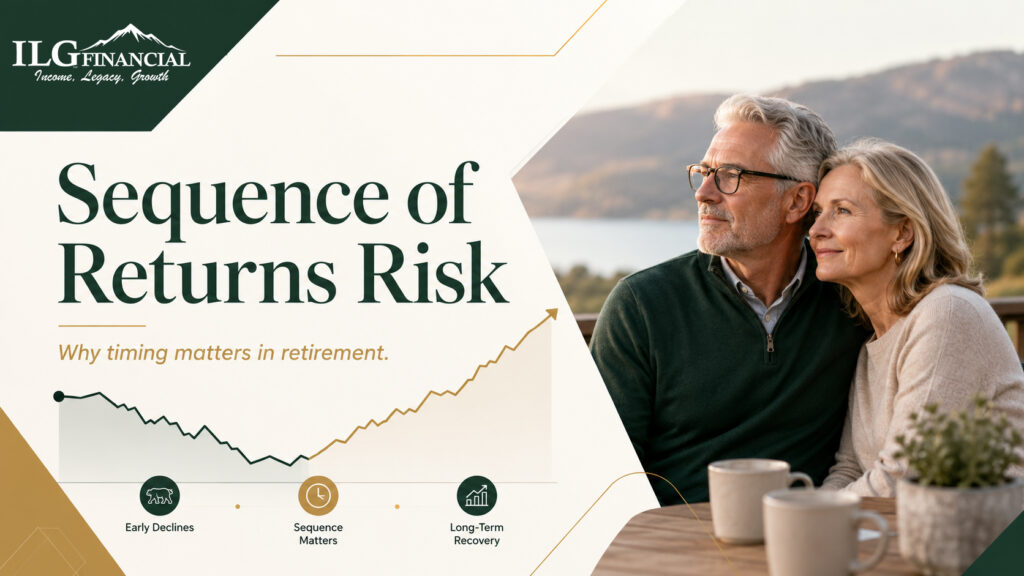
When you are saving for retirement, investment performance is usually measured by average returns over time. Once you retire and begin taking withdrawals, however, the order in which those gains and losses occur can become just as important as the average return itself.
This is known as sequence of returns risk.
Sequence of returns risk refers to the possibility that poor market performance early in retirement could significantly reduce the longevity of your portfolio. The concern is not simply whether the market rises or falls. It is when those gains and losses occur in relation to your withdrawals.
Why Retirement Changes the Equation
During your working years, you are generally contributing money to your accounts rather than withdrawing it. If the market declines, you may have time to recover before those assets are needed.
Retirement introduces a different dynamic. You are no longer just investing for growth. You are also using the portfolio to help fund your lifestyle.
When withdrawals are made during a market downturn, you may be forced to sell investments after they have lost value. Those assets are then no longer available to participate in a future recovery. As a result, early losses combined with ongoing withdrawals can create lasting damage.
The whitepaper illustrates this difference by comparing two hypothetical $1 million portfolios experiencing the same market returns in opposite order. During the accumulation phase, both portfolios ultimately reach the same ending value because no withdrawals are being taken. However, when annual withdrawals of $50,000 are introduced during retirement, the results are dramatically different. One portfolio is depleted, while the portfolio that experiences stronger returns earlier retains more than $1 million after 20 years.
The example is hypothetical, but the lesson is important: two retirees can earn the same average return and still have very different outcomes.
Managing Sequence Risk
No one can reliably predict when the next market decline will occur, but thoughtful retirement planning can help reduce the potential impact.
A retirement income strategy may include maintaining a reserve of cash or conservative assets for near-term expenses. This can help limit the need to sell investments during a downturn. Other approaches may include adjusting withdrawal levels, diversifying among different asset classes, evaluating guaranteed income sources and regularly rebalancing the portfolio.
The appropriate strategy will depend on your income needs, time horizon, risk tolerance and other financial resources.
A Different Investment Mindset
The transition from saving for retirement to living in retirement requires more than simply continuing the same investment approach. During the accumulation years, the primary objective is often growth. During the distribution years, the focus expands to include income, liquidity, risk management and portfolio sustainability.
Sequence of returns risk is a reminder that retirement planning is not based solely on how much you have saved. It also involves determining how those assets will be invested and withdrawn over time.
A well-constructed retirement income plan cannot eliminate market risk, but it can help you prepare for unfavorable conditions and make more informed decisions when volatility occurs.

 Buckle Up: Why Markets Could Get Bumpy This Fall
 Setting Effective Financial Goals for Sustainable Success
 Understanding Where Protected Income Strategies May Fit Within a Retirement Plan
 Charitable Giving Strategies: Planning Your Giving Before Year-End to Support Causes That Matter to You
 Taking a Proactive Approach to Important Financial Decisions Before Year-End
 This Charge Doesn’t Add Up
 Tax Diversification in Retirement: Building Flexibility for Future Income Needs
 Understanding the Difference Between Risk Tolerance, Risk Capacity, and Financial Goals
 Back-to-Routine Money Reset: Taking Stock Before the End of the Year
 Planning for Longevity: Preparing for a Retirement That May Last Decades
 Why Putting Your Financial Strategy in Writing Matters
 Summer Financial Checkup: Reviewing Your Progress and Priorities

 Israel Chavez, Jr. joined the ILG Financial team in 2026 as a Service Advisor. A graduate of Howard University, Israel was also a Division I student-athlete, competing as a goalkeeper for the university’s soccer program. His experience balancing academics and collegiate athletics helped shape the discipline and competitive mindset he brings to his role at ILG Financial.
 Megan Jones joined the ILG Financial team in 2020 as marketing director. Megan and her husband live in Fredericksburg, VA with their German Short Haired Pointer, Gus. Megan is a graduate of Longwood University and holds a degree in communications. Megan is the oldest of Dave Lopez’s three children and not only enjoys working alongside her father, but also with her cousin, Chase, who joined the ILG Financial team in 2020 as an advisor. Megan is also a fully licensed Life, Health, and Annuity agent. When not at work, Megan enjoys sitting on the back porch with family and friends enjoying food and music.
 Amy Anderson joined the ILG Financial team in 2023 as the client relations coordinator. Her responsibilities include scheduling of appointments, annual check-up notifications, and annuity and required minimum distribution assistance. She is a graduate of Harding University with a degree in Computer Information Systems. Amy and her husband have two children and she enjoys reading, crocheting, music and spending time with her family.
 Terri Center joined the ILG Financial team in 2019 as client services manager. She handles client records, application processing, and gathering information to provide a professional and friendly experience with all of our clients. Terri is a graduate of Oakland University. She is married and has two children. She enjoys hiking, family time, and puzzle challenging video games. She also likes to share her creativity in her canvas paintings and sewing projects.
 Jessica Carson joined the ILG Financial team in 2018 as an agent. Jessica and her husband have four children, two dogs, 3 barn cats, 5 chickens, and three parakeets. She indeed loves her children and pets! When not at work, Jessica enjoys playing the piano and cello as well as traveling and spending time outside with her family, hiking, fishing, and boating.