
For many people approaching retirement, Social Security is one of the most familiar parts of the planning process. You may know you are eligible to begin benefits at a certain age. You may have seen estimates of your monthly benefit. You may even have a target claiming age in mind.
But deciding when to claim Social Security is not always as simple as choosing the earliest available date or waiting as long as possible.
Your claiming decision may affect more than your first monthly check. It can also influence your long-term income plan, household income, survivor considerations, tax planning, and how your other retirement resources are used over time.
At ILG Financial, we believe Social Security should be considered as part of a broader retirement income strategy, not as a decision made in isolation.
Social Security Timing Is a Retirement Income Decision
Social Security often serves as a foundational source of retirement income. For many retirees, it provides income that continues for life and may help support essential expenses.
Because of that, timing matters.
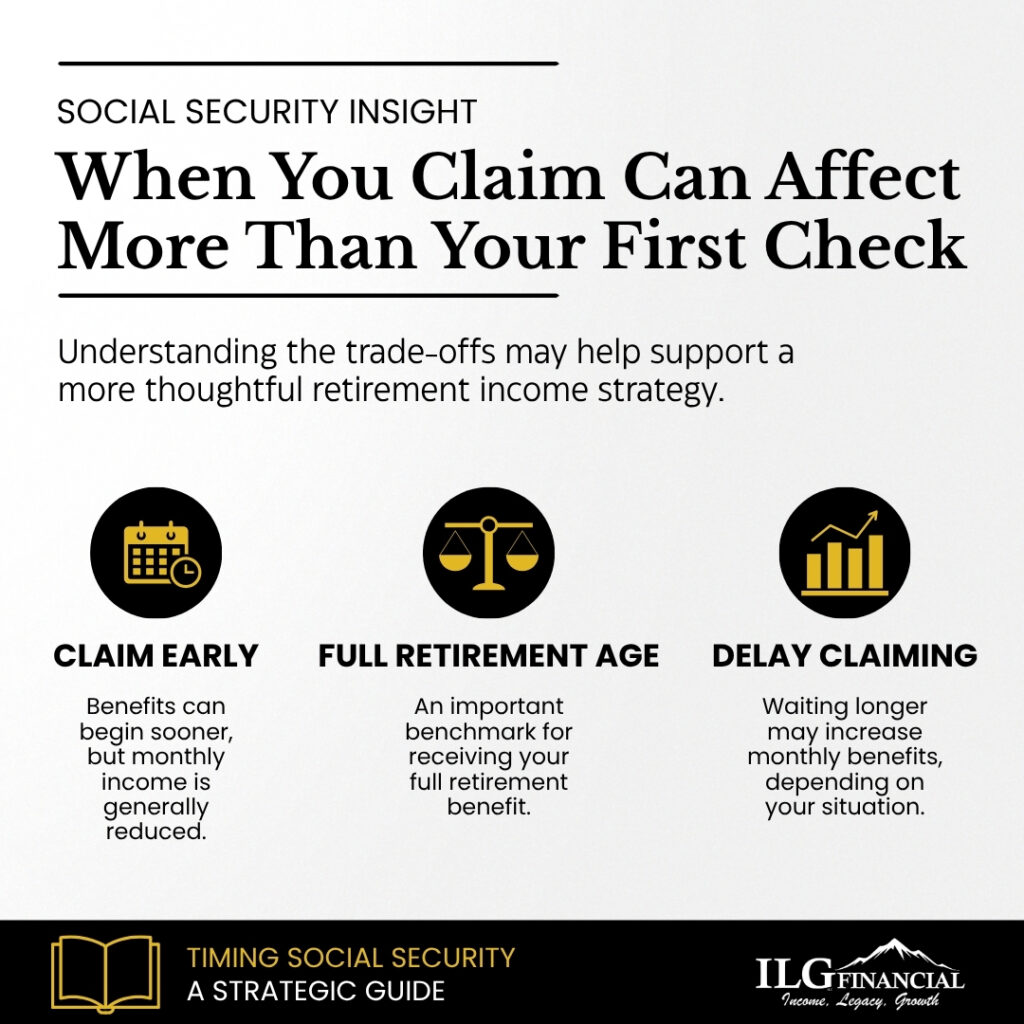
Claiming earlier generally provides income sooner, but it usually results in a reduced monthly benefit. Waiting longer may increase the monthly benefit, but it requires a plan for how income will be provided before benefits begin.
Neither approach is automatically right or wrong. The better question is how your claiming decision fits into your broader retirement income strategy.
Full Retirement Age Is a Benchmark, Not a Recommendation
Full Retirement Age, often called FRA, is the age when you may be eligible to receive your full Social Security retirement benefit based on your earnings record.
It is an important planning benchmark, but it is not automatically the best age for everyone to claim.
Some individuals may need income earlier. Others may have resources that allow them to delay. Some couples may coordinate claiming decisions based on household income or survivor benefit considerations. Health, family history, employment, taxes, and other retirement income sources may all influence the decision.
The key point is this: eligibility does not necessarily mean it is the right time to begin benefits.
Claiming Early vs. Waiting Longer
One of the most common Social Security questions is whether to claim early or wait.
Claiming earlier may provide income sooner, which can be helpful for those who retire earlier than expected, need cash flow, or have health or family considerations that influence timing.
Waiting longer may increase the monthly benefit, which can support long-term income planning. However, delaying benefits generally requires another source of income during the waiting period.
That trade-off is why the decision should not be made in isolation.
For Couples, the Decision May Affect More Than One Person
Social Security decisions can be especially important for married couples because one person’s claiming decision may affect household income over time.
In some cases, spousal or survivor considerations may influence how a couple evaluates timing. For example, the timing of one spouse’s benefit may affect income available to a surviving spouse later.
This is one reason Social Security should often be viewed at the household level, not just as an individual decision.
Taxes May Also Play a Role
Many retirees are surprised to learn that Social Security benefits may be taxable depending on overall income.
Other income sources, such as IRA withdrawals, pensions, wages, or investment income, may affect how benefits are taxed. This means Social Security should be considered alongside the rest of your retirement income plan.
The timing and coordination of income sources can influence your broader tax picture, which is why Social Security planning and retirement income planning often need to work together.
Questions to Ask Before Claiming Social Security
Before deciding when to claim, it may be helpful to ask:
- When will I need income from Social Security?
- How would claiming earlier or later affect my monthly benefit?
- How might my decision affect my spouse or survivor benefits?
- Could my other retirement income affect how my benefits are taxed?
- What other resources could provide income if I delay benefits?
- How does Social Security fit into my broader retirement income plan?
These questions do not always have simple answers, but they can help create a more informed planning conversation.
Start the Conversation
Social Security is an important retirement decision, but it does not need to be made alone or in isolation. A thoughtful conversation can help you evaluate how your claiming strategy may fit into your broader retirement income plan.
To learn more, download our guide:
Timing Social Security: What to Consider Before You Claim
This guide walks through key concepts, including Full Retirement Age, claiming early versus waiting, spousal and survivor considerations, taxes, and questions to discuss before making a claiming decision.
Click here to download.
This material is for informational purposes only and is not intended as tax, legal, Social Security claiming, or investment advice. Individuals should consult with qualified professionals regarding their specific circumstances before making financial decisions.
Recent Posts
 Buckle Up: Why Markets Could Get Bumpy This Fall
 Setting Effective Financial Goals for Sustainable Success
 Understanding Where Protected Income Strategies May Fit Within a Retirement Plan
 Charitable Giving Strategies: Planning Your Giving Before Year-End to Support Causes That Matter to You
 Taking a Proactive Approach to Important Financial Decisions Before Year-End
 This Charge Doesn’t Add Up
- Scam of the Month: One Letter Away from a Scam
 Tax Diversification in Retirement: Building Flexibility for Future Income Needs
 Understanding the Difference Between Risk Tolerance, Risk Capacity, and Financial Goals
 Back-to-Routine Money Reset: Taking Stock Before the End of the Year
- Scam of the Month: This Job Won’t Work
 Planning for Longevity: Preparing for a Retirement That May Last Decades
 Why Putting Your Financial Strategy in Writing Matters
 Summer Financial Checkup: Reviewing Your Progress and Priorities
- Scam of the Month: FIFA Phishing






 Israel Chavez, Jr. joined the ILG Financial team in 2026 as a Service Advisor. A graduate of Howard University, Israel was also a Division I student-athlete, competing as a goalkeeper for the university’s soccer program. His experience balancing academics and collegiate athletics helped shape the discipline and competitive mindset he brings to his role at ILG Financial.
 Megan Jones joined the ILG Financial team in 2020 as marketing director. Megan and her husband live in Fredericksburg, VA with their German Short Haired Pointer, Gus. Megan is a graduate of Longwood University and holds a degree in communications. Megan is the oldest of Dave Lopez’s three children and not only enjoys working alongside her father, but also with her cousin, Chase, who joined the ILG Financial team in 2020 as an advisor. Megan is also a fully licensed Life, Health, and Annuity agent. When not at work, Megan enjoys sitting on the back porch with family and friends enjoying food and music.
 Amy Anderson joined the ILG Financial team in 2023 as the client relations coordinator. Her responsibilities include scheduling of appointments, annual check-up notifications, and annuity and required minimum distribution assistance. She is a graduate of Harding University with a degree in Computer Information Systems. Amy and her husband have two children and she enjoys reading, crocheting, music and spending time with her family.
 Terri Center joined the ILG Financial team in 2019 as client services manager. She handles client records, application processing, and gathering information to provide a professional and friendly experience with all of our clients. Terri is a graduate of Oakland University. She is married and has two children. She enjoys hiking, family time, and puzzle challenging video games. She also likes to share her creativity in her canvas paintings and sewing projects.
 Jessica Carson joined the ILG Financial team in 2018 as an agent. Jessica and her husband have four children, two dogs, 3 barn cats, 5 chickens, and three parakeets. She indeed loves her children and pets! When not at work, Jessica enjoys playing the piano and cello as well as traveling and spending time outside with her family, hiking, fishing, and boating.